You pay no income tax on your salary in the UAE, so almost all of it reaches your account. Plenty of people still run short before payday. The problem usually isn't everyday spending. It's the big payments that arrive a few times a year: a rent cheque, a school term, flights home in summer. A budget built only around monthly bills doesn't see them coming.
This guide shows you how to create a monthly budget in the UAE that plans for those payments too. You'll get seven steps, a sample budget in AED with real numbers, and a section for freelancers and small business owners who need to keep company money apart from their own.
Why budgeting in the UAE is different
Most budgeting advice is written for the US or UK, where tax comes out of your pay and rent goes out monthly. Here, a few things work differently.
Your take-home pay is close to your gross salary. That feels generous, but it tempts you to plan against the full figure, including allowances that could change if you switch jobs.
Rent usually goes out in one to four post-dated cheques. On a AED 78,000 apartment paid in four cheques, AED 19,500 leaves your account every three months. If you haven't been setting money aside, that cheque takes more than a month's salary for many people.
Housing also takes a bigger share of income than most guides assume. In Dubai and Abu Dhabi, rent often takes 35 to 45 percent of a salary.
If you're an expat, you're also paying for things the typical guide never mentions: money sent home, flights to see family, and visa and Emirates ID renewals. End-of-service gratuity helps when you leave a job, but it's a one-off payment, not a pension. Saving for retirement is up to you.
UAE monthly expenses to include in your budget
Before you set any numbers, list everything you pay. Open your last three months of bank and card statements and sort each payment into one of these groups.
Fixed monthly costs:
- Rent, as a monthly amount even if you pay by cheque
- The Dubai housing fee, charged on your DEWA bill at 5% of annual rent
- Chiller fees, if your building bills them separately
- Car loan or lease
- Phone and internet with e& or du
- Health insurance for family members your employer doesn't cover
- ILOE unemployment insurance (AED 5 a month on a basic salary of AED 16,000 or less, AED 10 above that)
Variable costs:
- Electricity and water from DEWA, ADDC or SEWA, which climb sharply in summer when the AC runs all day
- Groceries
- Fuel, Salik tolls and parking
- Taxis and ride-hailing
- Food delivery and eating out
Annual and irregular costs:
- School fees, usually billed by term
- Car registration and insurance
- Visa and Emirates ID renewals
- Flights home
- Ramadan and Eid spending, including gifts
- Summer holidays
The last group covers money you move rather than spend: remittances, credit card repayments, emergency savings and investments.
How to create a monthly budget in the UAE, step by step
1. Work out your real monthly income
Start with your net salary plus any allowances you receive every month. Leave out annual bonuses and one-off payments, and decide where each one goes when it arrives. If your income varies, as it does for freelancers and people on commission, budget from your lowest month in the past year.
2. Turn annual costs into monthly ones
This is the step most people skip. Add up every yearly cost and divide it by 12. Rent of AED 78,000 becomes AED 6,500 a month, and AED 3,000 in flights home becomes AED 250. Put those amounts in your budget like any other bill, and move them into a separate savings account every payday so the money is there when the cheque clears.
3. List your fixed bills
Write down each fixed cost from the checklist above with its exact amount. They decide how much room is left for everything else.
4. Set limits for variable spending
Check your statements to see what you actually spent on groceries, fuel, delivery and the rest over the last two or three months. Use the average as your starting limit. If a number shocks you, trim it by 10 to 20 percent rather than halving it overnight.
5. Pay savings and remittances first
Treat savings and money for family as bills, paid on the day your salary lands. A standing order on payday takes the decision out of your hands.
6. Choose a budgeting method that fits UAE costs
The 50/30/20 rule splits income into 50% needs, 30% wants and 20% savings. It's simple, but it often doesn't fit here. In the sample budget below, needs take 75% of a AED 15,000 salary, mostly because of rent. That doesn't mean the person is careless. The rule was written for places with cheaper housing.
Zero-based budgeting usually works better. You give every dirham a job until income minus spending, savings and remittances equals zero.
7. Track spending and review once a month
Your budget only helps if you compare it with what really happened. Log spending at least once a week, then spend 15 minutes at the end of the month on a review. Look at which categories went over, decide whether the limit was unrealistic or the spending was, and adjust next month's numbers. An app that tracks expenses by category and warns you before you cross a spending limit makes this much faster.
Sample UAE monthly budget on a AED 15,000 salary
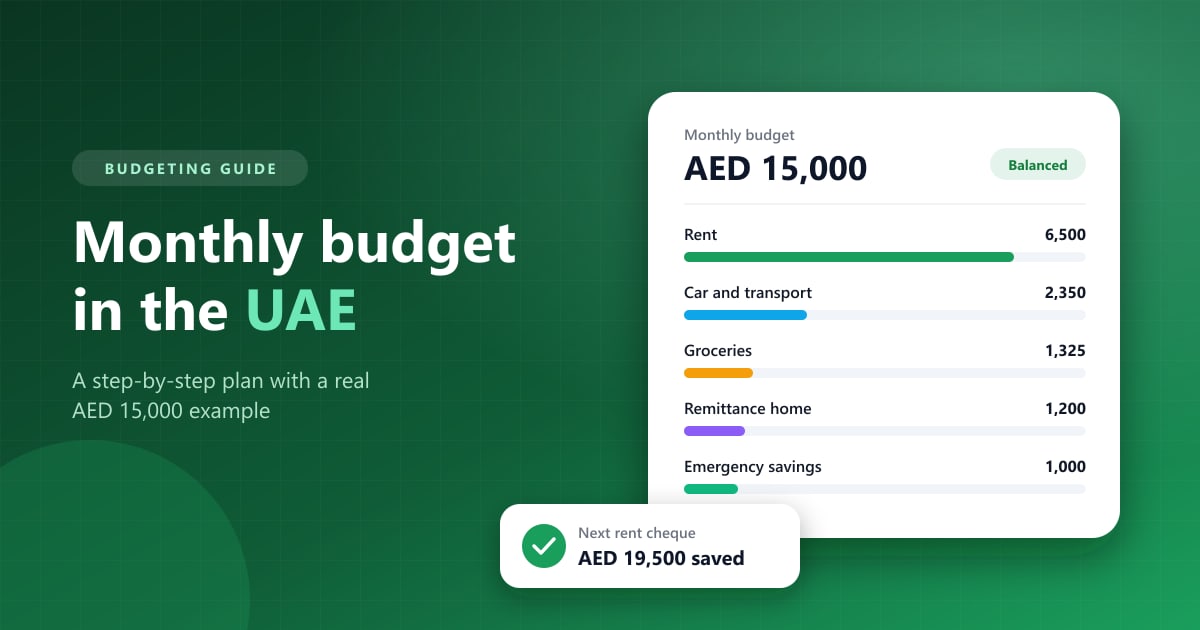
Here's how it works for a single professional renting a one-bedroom apartment in Dubai and running a car. The figures are an illustration, so yours will differ. The first draft is what most people write down. The final column shows it after the cuts that made it balance.
| Category | First draft (AED) | Final (AED) | % of income |
|---|---|---|---|
| Rent (AED 78,000 ÷ 12) | 6,500 | 6,500 | 43% |
| Housing fee (5% of rent) | 325 | 325 | 2% |
| DEWA | 400 | 400 | 3% |
| Phone and internet | 450 | 350 | 2% |
| Car loan | 1,400 | 1,400 | 9% |
| Fuel | 400 | 400 | 3% |
| Salik and parking | 250 | 250 | 2% |
| Car insurance and registration (÷ 12) | 300 | 300 | 2% |
| Groceries | 1,500 | 1,325 | 9% |
| Eating out and delivery | 1,200 | 600 | 4% |
| Subscriptions and gym | 350 | 200 | 1% |
| Shopping and personal | 800 | 500 | 3% |
| Remittance home | 1,500 | 1,200 | 8% |
| Flights home (÷ 12) | 250 | 250 | 2% |
| Emergency savings | 1,000 | 1,000 | 7% |
| Total | 16,625 | 15,000 | 100% |
The first draft came in AED 1,625 over. Rent, the car loan and savings stayed the same. Half the gap closed by cutting delivery in half. The rest came from shopping, subscriptions, a cheaper internet plan, a tighter grocery limit and a slightly smaller monthly remittance, with a larger transfer home whenever a bonus arrives.
Savings of 7% is below what most advice recommends, and that's the honest picture on this salary with this rent. The best way to raise it is to put half of every future pay rise straight into savings before your spending grows to match it.
How to handle rent cheques, school fees and other big payments
The answer to all of them is a sinking fund: a separate savings account that gets the monthly share of each big cost on payday. With rent of AED 78,000 in four cheques, AED 6,500 a month builds up to the AED 19,500 each cheque needs by the time the landlord cashes it.
School fees work the same way. Divide the annual fee by 12 and treat it like rent. Paying a whole term out of one month's salary is how many families end up putting fees on a credit card.
Ask your landlord what fewer cheques would cost. Some landlords accept a lower rent for one or two cheques. If you have the savings, compare that discount with what the money would earn in a savings account.
Mark the expensive months on your calendar too: high DEWA bills and flights in summer, Ramadan and Eid, and back-to-school at the end of August. Add them to your sinking fund totals instead of hoping those months will cope. Tracking each fund as a savings goal shows you at a glance whether you're on schedule.
Budgeting with credit cards in the UAE
Card statement dates rarely line up with payday. Something you buy on the 25th might not appear on a bill until the following month, so a budget built on last month's card payment is always a step behind. Count spending on the day you make it and your budget stays accurate whatever the statement cycle.
Instalments need the same care. A 0% plan from your bank, or a split payment with Tabby or Tamara, makes each purchase look small, and several of them running at once add up fast. List every active instalment as a fixed bill until it ends.
Pay the full balance every month if you can. Interest on UAE credit cards often runs above 3% a month, far more than any savings account pays. If you use more than one card, credit card tracking shows each card's spending and statement in one place.
Monthly budgeting for small business owners and freelancers
If you run a business or freelance, keep business and personal money in separate bank accounts. Pay yourself a fixed monthly salary from the business account and run your personal budget on that figure, exactly as an employee would. When the business has a strong month, the extra stays in the business account as a buffer.
Tax needs its own line. VAT registration is mandatory once your taxable supplies pass AED 375,000 a year. The 5% VAT you collect was never your money, so move it into a separate account each month and the quarterly return won't come as a shock. Corporate tax is 9% on taxable profit above AED 375,000, and smaller businesses may qualify for relief. Set aside a share of profit every month rather than finding it all at year end. The rules change, so confirm the current thresholds with the Federal Tax Authority or your accountant. This section isn't tax advice.
Add the business's annual costs to your sinking fund as well: trade licence renewal, visas for you and your staff, and any office or co-working contract. With irregular income, build a buffer of at least three months of expenses before you raise your own salary. Running separate budgets for each account keeps the two sides from blurring.
Choosing a budget planner in the UAE
A spreadsheet works if you're disciplined about typing in every transaction. Stop updating it for a few busy weeks, though, and it can't warn you about anything.
An app is worth it when you want reports and alerts without the manual work. Look for AED as the default currency, budgets by category, and a way to track annual costs and savings goals. Think twice before giving any app your bank login.
Fixpenses was built for the UAE. It uses AED by default, sets category budgets that alert you before you overspend, tracks savings goals and credit cards, and never asks for your bank login. You can see all the features or compare plans.
Frequently asked questions
What is a good monthly budget for a single person in the UAE?
It depends mostly on rent. Use the sample above as a template: fixed costs first, then variable limits, then savings. Try to keep rent under about 40% of take-home pay and save at least 10%.
Does the 50/30/20 rule work in the UAE?
For many residents it doesn't, because rent pushes needs well past 50%. Treat it as a target to work toward, or use zero-based budgeting instead.
How much should I save each month in the UAE?
Start with an emergency fund covering three to six months of expenses. Losing your job can affect your residence visa, so lean toward six. After that, save for retirement, since gratuity won't cover it.
How do I budget for rent paid by cheque?
Divide the annual rent by 12 and move that amount into a separate account every payday. By the time each cheque is due, the money is already there.
Do I pay tax on my salary in the UAE?
No. There's no personal income tax on salaries. You pay 5% VAT on most purchases, and businesses may owe VAT and corporate tax.
Start with next month
A UAE budget works when it treats rent cheques, school fees and flights home as monthly bills. Pull up your last three months of statements tonight, list every annual cost, and divide by 12. That one number shows how much you really have to spend.