Figures checked September 2026. Bank and provider fees change, so confirm current terms before you commit.
Walk into almost any electronics shop in Dubai and you'll see the sign: 0% installments, 12 months, no interest. Your bank sends the same offer by SMS the day after a big purchase. Split a AED 4,800 laptop into twelve payments of AED 400 and nobody charges you a dirham of interest.
That's mostly true. The interest really is zero. But a credit card installment plan in the UAE usually comes with costs that don't appear on the shop's sign: a processing fee, lost rewards, a fee for paying early, and a chunk of your credit limit tied up for a year. None of these make taksit a bad deal, but together they mean it isn't free. Know the full price before you say yes.
This guide explains how 0% plans work, what they cost in AED, and when they're a smart choice.
How 0% installment plans work in the UAE
There are three common versions, and they're easy to mix up.
Merchant 0% plans
The shop has an agreement with your bank. You pay with your credit card at a participating store, and the purchase is split into equal monthly amounts over 3 to 24 months. The merchant pays the bank for the interest-free period, which is why the store is happy to advertise it.
Converting a purchase after the fact
Many UAE banks let you turn a recent card purchase into an installment plan through the app or by calling them. Emirates NBD, for example, only allows transactions from your latest statement or current billing cycle. These plans may be 0% at participating merchants, or carry interest at other stores.
Balance conversion plans
Some banks will convert your whole outstanding card balance into a fixed monthly plan. These are rarely 0%. They carry a reducing rate and are really a loan, even if they're sold as "easy payments".
When you hear "0% taksit", it usually means the first type. The catches below apply mostly to the first two.
The costs that aren't on the sign
Processing fees
Most banks charge a one-off processing fee to set up the plan. At Emirates NBD, the standard fee on 0% plans is AED 51.45 including VAT per transaction, though the bank sometimes waives it as a promotion. Other banks charge either a flat fee or a percentage of the purchase. Check your bank's Key Facts Statement for the exact number.
On a AED 5,000 purchase, AED 51 is about 1 percent. On a AED 800 purchase, it's over 6 percent, which is more than a month of credit card interest.
Lost rewards
This is the cost most people miss. Many UAE cards don't give you points, miles or cashback on transactions converted to a 0% plan. Emirates NBD's terms say rewards are forfeited on 0% plans except on certain cards.
If your card normally earns 1.5 percent cashback, converting a AED 3,600 purchase costs you AED 54 in rewards you would otherwise have earned.
Early settlement fees
Paying the plan off early sounds responsible, but it can cost you. Emirates NBD charges 1.05 percent of the remaining balance, including VAT, to close a plan early. If you think you might pay off the purchase with a bonus, check this fee first.
Your credit limit stays blocked
The full purchase amount usually comes off your available credit limit on day one. Your limit is only freed up as each installment is paid. Buy a AED 6,000 phone on a card with a AED 15,000 limit and you have AED 9,000 of room left for the rest of the year, not AED 14,500.
That matters if you use your card for emergencies or for monthly spending you clear in full.
Missing a card payment makes it expensive fast
Your monthly installment is added to your card statement, and it's included in your minimum payment in full. If you miss the payment due date, you pay the late fee on the whole card, which is AED 241.50 a month at Emirates NBD. You'll also be charged interest on the rest of the statement balance if you don't clear it in full.
The installment itself stays at 0%. Everything around it doesn't.
What a 0% plan costs: a worked example
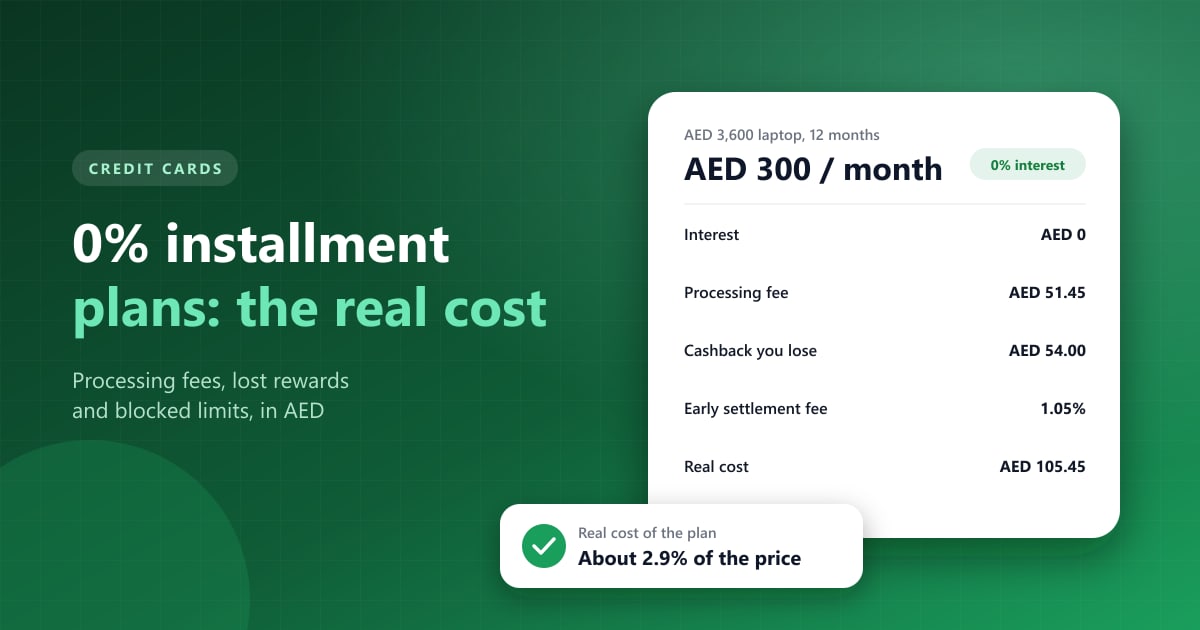
Say you're buying a AED 3,600 laptop at a partner store and your card earns 1.5 percent cashback.
| Cost item | Amount (AED) |
|---|---|
| Interest | 0 |
| Processing fee | 51.45 |
| Cashback you don't earn | 54.00 |
| Total real cost | 105.45 |
That's about 2.9 percent of the price, spread over a year. It's still far cheaper than carrying AED 3,600 on your card at a typical 3.25 to 3.49 percent a month (Emirates NBD KFS), which would cost AED 117 to AED 126 in interest in the first month alone.
So the maths usually works in favour of the plan if the alternative is carrying a balance. It works against the plan if the alternative is paying in full from your salary or savings. In that case, you're paying AED 105 for the convenience of spreading a cost you could have covered.
0% plan vs personal loan vs saving up first
A 0% plan isn't the only way to pay for something big. Here's how it compares with the other two common options for a AED 3,600 purchase.
| 0% card plan | Personal loan | Save up first | |
|---|---|---|---|
| Cost | About 1 to 3% (fee plus lost rewards) | Interest for the whole term, plus possible fees | Nothing |
| Monthly commitment | Fixed, 3 to 24 months | Fixed, usually 12 months or more | None after purchase |
| Effect on credit | Blocks card limit until paid | New loan on your credit report | None |
| When you get the item | Today | After approval | When you've saved |
For purchases under a few thousand dirhams, a personal loan rarely makes sense. The choice is really between a 0% plan and waiting a few months. If the thing you want can wait, saving for it is always cheaper. If it can't, because your laptop has died and you work from it, a 0% plan is usually the least expensive way to get it now.
How to convert a purchase in your bank app
If you've already paid with your card, most UAE banks let you convert the transaction into a plan yourself. The steps are similar across banks:
- Open your bank's app and go to your credit card.
- Find the transaction, usually under recent or unbilled transactions.
- Look for an option such as "convert to installments" or "easy payment plan".
- Choose the number of months and review the fee and monthly amount shown.
- Confirm, then check your next statement to make sure the plan appears correctly.
Do this before your statement is generated if you can. Some banks only allow conversion within the current cycle or the latest statement, and once the window closes, the full amount is due as normal.
When a 0% plan makes sense
Taksit is a good tool when all of these are true:
- You'd otherwise carry the balance on your card and pay interest
- The installment fits inside your monthly budget without cutting savings
- The purchase is something you'd buy anyway, at the same price
- The processing fee is small compared with the purchase amount
- You won't need the blocked credit limit for something else
It makes less sense when:
- You have the cash and the processing fee is more than the rewards you'd lose by paying in full
- The shop's price is higher than elsewhere, which cancels out the 0%
- You already have two or three plans running
- The purchase is small, so the fee is a large percentage of it
- You're buying it because the monthly figure feels small, not because you need it
That last one is the biggest risk. AED 400 a month doesn't feel like a laptop, it feels like a phone bill, and that makes it easy to spend more than you planned.
The stacking problem
One plan is manageable. The trouble starts when a phone, a sofa, a TV and a school fee plan are all running at once, each with a different end date. Individually, none of them looks big. Together, they can take AED 2,000 or more of your salary every month before you've bought groceries.
Here's how it usually happens. In January, a laptop goes on a 12-month 0% plan at AED 400 a month. It's comfortable. In March, a new TV for Ramadan adds AED 250 a month. In June, the sofa for the new flat adds AED 350. In August, the school fee plan adds AED 1,100. None of those decisions felt big on the day, because each was compared with the salary, not with the plans already running. By September, AED 2,100 of a AED 15,000 salary is gone before rent, and the household is wondering why every month feels tight.
Plans also show up on your credit report, and banks look at your total monthly commitments when you apply for a loan or another card. A pile of small plans can make a bigger application harder.
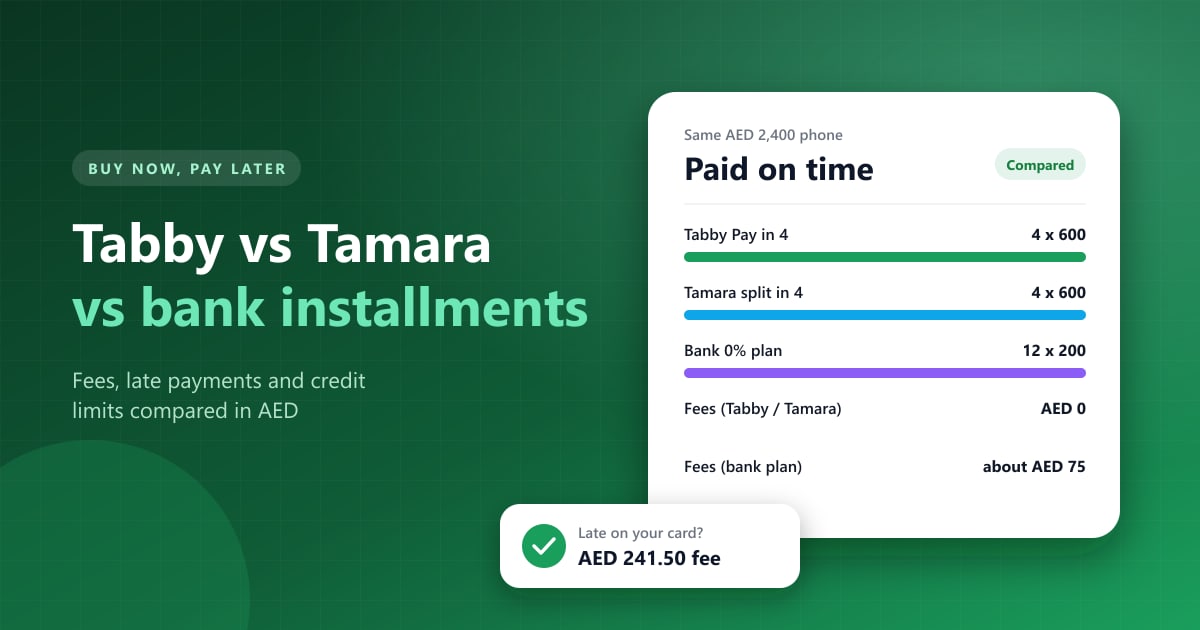
Before you add a new plan, add up every installment you're already paying, including buy-now-pay-later services like Tabby and Tamara. If you want a side-by-side comparison of those, see Tabby vs Tamara vs bank installments.
How to budget for installment plans
Treat each plan as a fixed monthly bill, like rent or your phone contract. That means:
- List every active plan with the monthly amount, the card it's on, and the month it ends.
- Add the total to your fixed costs in your monthly budget, not your variable spending.
- Set a ceiling. A simple rule is that all installments together shouldn't exceed 10 percent of your take-home pay.
- Mark the end dates. When a plan finishes, move that monthly amount straight into savings for a few months before you let yourself start a new one.
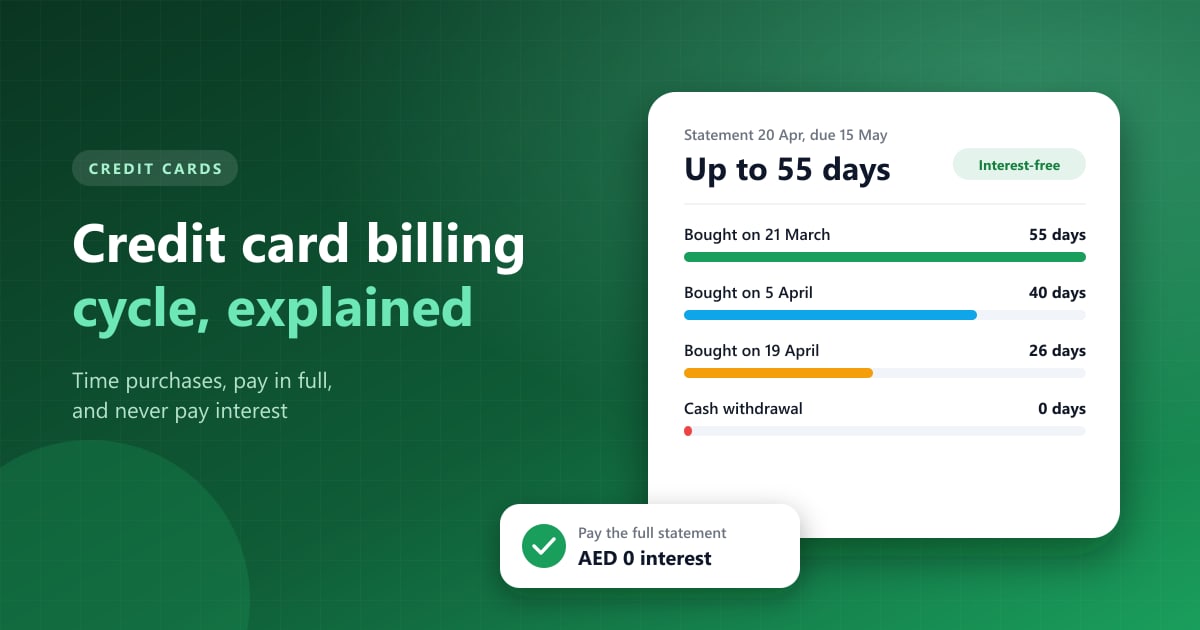
- Watch your statement cycle. Knowing when each card statement closes helps you time purchases and avoid surprises. Our guide to credit card statement cycles in the UAE explains how.
Fixpenses tracks installment plans alongside your credit cards, showing what's left to pay on each one and when it finishes. That makes it much harder for a fourth plan to sneak in unnoticed.
Questions to ask before you say yes
Ask the shop or bank these questions before you sign:
- Is there a processing fee, and is it being waived?
- Is the price the same as paying in full today?
- Will I lose rewards or cashback on this purchase?
- What does it cost to settle early?
- Which merchants qualify, and is this store one of them?
- How many months can I choose, and does the fee change with the term?
If the salesperson can't answer, the bank's app or Key Facts Statement will.
Frequently asked questions
Are 0% installment plans Sharia compliant?
Some Islamic banks offer their own installment products structured to be Sharia compliant. Conventional bank plans are interest-free on the installment, but check with an Islamic bank if that matters to you.
Can I convert a purchase I've already made?
Often, yes. Most UAE banks allow you to convert recent card transactions through their app, usually within the current statement or billing cycle. Whether it's 0% depends on the merchant.
Does an installment plan affect my credit score?
The plan is part of your credit card account, and your repayment history is reported to Al Etihad Credit Bureau. Paying on time helps. Missing payments hurts.
What happens if I cancel my card during a plan?
You'll normally need to pay the remaining balance in full, and an early settlement fee may apply. Check your bank's terms before closing the card.
The bottom line
A 0% installment plan in the UAE really is interest-free, but it isn't free. Once you add the processing fee, lost rewards and blocked credit, expect to pay around 1 to 3 percent of the purchase price. That's a good deal compared with credit card interest and a poor one compared with paying cash.
Before your next taksit, write down the plan's real cost and your total monthly installments. If both numbers still look reasonable, go ahead. If the second one makes you wince, that's your answer.