Figures checked September 2026. Bank and provider fees change, so confirm current terms before you commit.
UAE credit cards charge some of the highest interest rates you'll ever pay. At Emirates NBD, for example, the monthly rate on purchases is 3.25 to 3.49 percent, which works out to around 39 to 42 percent a year. Yet the same card can cost you nothing at all if you understand one thing: the credit card billing cycle.
Most people who pay interest aren't reckless spenders. They just don't know which date matters, or they assume paying the minimum keeps them safe. This guide explains how statement cycles work in the UAE, how the interest-free period is calculated, why the minimum payment is a trap, and how to line everything up with your salary so you never pay a dirham of interest.
The figures below come from Emirates NBD's Key Facts Statement, which is typical of UAE banks. Your bank's numbers may differ slightly, so check your own Key Facts Statement, which every UAE bank publishes.
The three dates on every card
Every card has three dates that repeat each month.
The statement date
This is when your billing cycle closes. Everything you spent in the previous month or so gets added up into one statement. Anything you buy after this date goes on next month's statement.
The due date
This is the deadline to pay. It usually falls a few weeks after the statement date, depending on the bank.
The transaction date
This is the day you buy something. It matters because interest, when it applies, is often calculated from this date rather than from the statement date.
The period between one statement date and the next is your billing cycle. The gap between the statement date and the due date is your grace period.
How the interest-free period works
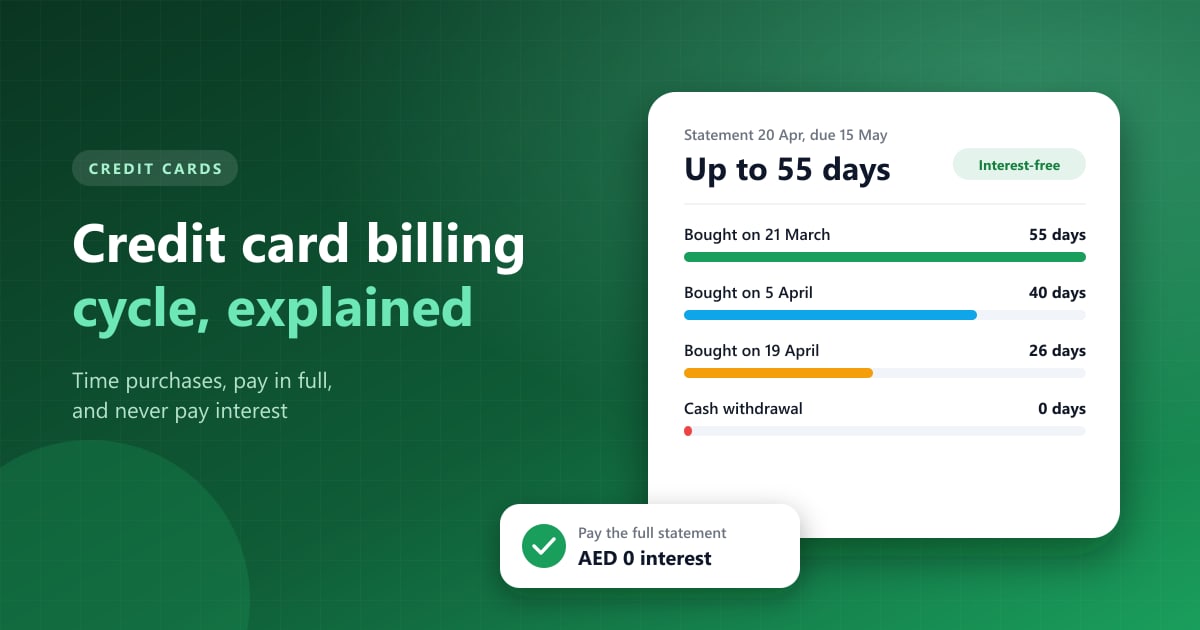
Banks advertise "up to 55 days interest-free". Emirates NBD's Key Facts Statement lists up to 55 days on retail purchases. Note the "up to". How many days you get depends on when in the cycle you buy.
Say your statement date is the 20th and your due date is the 15th of the next month.
- Buy something on 21 March. It lands on the statement that closes on 20 April, due 15 May. That's about 55 days before you have to pay.
- Buy something on 19 April. It lands on that same 20 April statement, also due 15 May. That's only about 26 days.
Same card, same bank, twice the interest-free time, just by knowing the date. For big planned purchases, buying the day after your statement date gives you the longest possible runway.
There's one condition that makes all of this work: you must pay the full statement balance by the due date. Pay in full, and you pay no interest on purchases. Pay anything less, and the free period usually disappears.
What happens when you don't pay in full
If you pay less than the full statement balance, most UAE banks charge interest on the unpaid amount, and often on new purchases too, until you've cleared the whole balance. Interest is usually calculated from each transaction date, not from the due date. Commercial Bank International's Key Facts Statement, for example, says interest applies from the transaction date whenever the statement balance isn't paid in full. That's why a bill can arrive with more interest than the leftover balance seems to justify.
Here's the mistake in real terms. Someone who always clears their card gets a AED 10,000 statement in a month with a car repair and a flight home. They pay AED 9,500 and leave AED 500 for next month, expecting interest of around AED 17, which is 3.49 percent of AED 500. The next statement shows a much bigger charge, because interest was calculated on each purchase from the day it was made, not just on the AED 500 left over. After a year of paying no interest at all, one partial payment wiped out the benefit.
Cash withdrawals are different again. They have no interest-free period at all, and at Emirates NBD there's also a cash advance fee of 3.15 percent or AED 103.95, whichever is higher. Using your credit card at an ATM is almost always the most expensive way to get money.
The minimum payment trap
Your statement shows a minimum payment due. At Emirates NBD it's 5 percent of the balance or AED 100, whichever is higher, plus any installments, overdue amounts and over-limit amounts in full.
Paying the minimum keeps your account in good standing. It avoids the late fee, which is AED 241.50 a month at Emirates NBD. But it doesn't avoid interest, and it barely touches the debt.
Here's how that looks on a AED 10,000 balance at 3.49 percent a month:
| Amount (AED) | |
|---|---|
| Balance | 10,000 |
| Minimum payment (5%) | 500 |
| Interest for the month | about 349 |
| Actual reduction in debt | about 151 |
Of the AED 500 you paid, roughly AED 349 went to interest. Your balance dropped by only about AED 151. Keep paying just the minimum, and it can take years to clear, costing thousands in interest along the way.
If you already have a balance you can't clear in one go, pay as much above the minimum as you can every month, stop adding new spending to that card, and consider whether a 0% balance transfer or an installment plan would cost less. Our guide to 0% installment plans walks through the costs.
If you already have card debt: a way out
If you're reading this with a balance you can't clear this month, the priority changes. Avoiding interest on new purchases matters less than shrinking the debt you already have.
- Stop using the card with the balance. New purchases on that card may attract interest straight away. Use a debit card or a different credit card you clear in full.
- Pay more than the minimum, every month. Even AED 300 above the minimum makes a big difference on a AED 10,000 balance. Most of the minimum goes to interest; everything above it goes to the debt.
- Target the most expensive balance first. If you have more than one card, put every spare dirham towards the one with the highest rate, while paying the minimum on the others. This is called the avalanche method and costs the least overall.
- Look at cheaper ways to hold the debt. A 0% balance transfer to another card, or converting the balance into an installment plan, can cut the interest you pay. Check the fees first. A one-off transfer fee of a few percent is still far less than paying over 3 percent every single month.
- Build a small buffer as you go. Once the debt is gone, a buffer of even one month's card spending in your current account means you'll never need to carry a balance again.
For a full plan that fits debt repayment alongside rent and bills, see how to create a monthly budget in the UAE.
How to line up your card with your salary
Most UAE salaries arrive around the same date each month. The simplest way to avoid interest is to make sure your card's due date falls a few days after payday, not before it.
- Find your dates. Look at your last statement for the statement date and due date.
- Compare with payday. If your salary lands on the 28th and your card is due on the 25th, you're always three days short.
- Ask your bank. Some UAE banks let you change your statement date through customer service or the app. Moving the due date a week after payday fixes the problem permanently.
- Set up an automatic full payment. Most banks let you set a standing instruction to pay the full statement balance from your current account on the due date. This is the single best habit for avoiding interest.
- Keep a buffer. Leave enough in your current account to cover the statement when the automatic payment runs.
Budgeting when you pay by card
Card spending causes a classic budgeting mistake. You spend AED 6,000 on your card in March, the statement arrives in April, and your April budget suddenly looks AED 6,000 worse than it really is.
The fix is to count spending on the day you make it, not the day you pay the bill. When you tap your card at the supermarket, that's this month's grocery spend, whatever the statement cycle says. Your card payment later is just moving money you've already spent.
This is also how you stay within budget during the month. If your grocery limit is AED 1,500 and you've already spent AED 1,300 on your card by the 20th, you know to slow down, even though no bill has arrived yet.
Fixpenses tracks each card's spending and statement separately, so you can see what's building up on every card before the statement lands. You can set spending limits by category and get alerted before you go over, and the credit card view shows balances and due dates for all your cards in one place.
For a full monthly plan that builds this in, see how to create a monthly budget in the UAE.
Juggling more than one card
With two or three cards, each has its own statement and due date. That can work in your favour, since you can use whichever card has just started a new cycle for big purchases, but it also means more dates to track.
A few rules keep it simple:
- Use one main card for everyday spending, including any Tabby or Tamara installments, and pay it in full every month.
- Set automatic full payments on every card, not just the main one.
- Don't let a card sit unused with a balance. Small forgotten balances collect interest and late fees.
- Keep a single list of every card's statement date, due date and current balance.
How your payments affect your credit score
In the UAE, banks report your credit card behaviour to Al Etihad Credit Bureau (AECB), which produces your credit score. Two things matter most. The first is paying on time, every time. A single late payment can stay on your report and affect future applications for loans and cards. The second is how much of your limit you use.
Using AED 9,000 of a AED 10,000 limit looks riskier to lenders than using AED 2,000, even if you pay in full every month. Paying part of your balance before the statement date lowers the amount reported, which can help if you're about to apply for a loan or mortgage.
Frequently asked questions
Do I pay interest if I pay the full statement balance?
On retail purchases, no. Paying the full statement balance by the due date means you pay no interest on those purchases. Cash advances are the exception, as they usually charge interest from the day you withdraw.
What does "unbilled" mean in my banking app?
Unbilled transactions are purchases you've made since your last statement date. They haven't appeared on a statement yet, so you don't have to pay them by the current due date. They'll show up on your next statement. Your "outstanding balance" usually includes both billed and unbilled amounts, which is why it can be higher than the amount due.
Is it bad to pay only the minimum?
It won't damage your credit score as long as you pay on time, but it's expensive. You'll pay interest at the card's monthly rate on the rest of the balance, and the debt shrinks very slowly.
Can I change my card's statement date?
Many UAE banks allow it on request. Contact your bank through the app or customer service and ask to move your statement date so the due date falls after your salary.
Does paying early help?
Paying before the statement date lowers the balance that appears on your statement, which can help your credit utilisation. Paying before the due date avoids late fees. Either is fine, as long as the full statement balance is paid by the due date.
The bottom line
A UAE credit card is either free or very expensive, and the difference comes down to two dates and one habit. Know your statement date so you can time big purchases. Know your due date so it falls after payday. Then set up an automatic payment of the full statement balance, and the card becomes a free 55-day buffer instead of a 40-percent loan.
Do one thing today: open your banking app, find your statement and due dates, and switch on automatic full payment.