Most months in the UAE are fine. Salary comes in, bills go out, there's something left. Then a rent cheque clears, or a school term invoice lands, and that one month takes everything plus a chunk of your credit limit. Nothing unexpected happened. You knew the cheque was coming a year ago.
A sinking fund solves this. It's money you set aside every month for a big cost you already know about, so that when the bill arrives, the cash is sitting there waiting. This guide shows you how to set one up in the UAE, which costs to include, how much to save each month, and what to do if the next cheque is due before you've saved enough.
If you haven't built a monthly budget yet, start with our guide on how to create a monthly budget in the UAE. Sinking funds are step two of that guide, expanded.
What a sinking fund is (and how it differs from an emergency fund)
A sinking fund is savings with a job and a date. "AED 24,000 for the January rent cheque" is a sinking fund. "AED 30,000 in case I lose my job" is an emergency fund.
The difference matters because you should never raid one to pay the other. Your emergency fund is for events you can't predict: a job loss, a medical bill, an urgent flight home. Your sinking funds are for events you can predict to the day. If you pay the rent cheque out of your emergency fund, you haven't used savings, you've just discovered you didn't have a plan for rent.
In practice, a sinking fund turns a large, lumpy cost into a small, boring monthly bill. AED 24,000 every three months becomes AED 8,000 every payday. Your budget stops having good months and disaster months.
Picture a common case. An engineer in Dubai Marina earns AED 18,000 a month and pays AED 84,000 a year in rent, split into four cheques of AED 21,000. Three months out of four, money feels fine. In cheque months, the salary covers the cheque and very little else, so groceries, fuel and a school uniform order all go on the credit card. It takes the next two months to clear that balance, just in time for the next cheque. His spending is normal. The trouble is a year of rent arriving in four big pieces, with nothing set aside in between. Moving AED 7,000 into a separate account every payday breaks that loop within one cycle.
The UAE costs that need a sinking fund
Go through your last 12 months of bank and card statements and pull out anything that isn't paid monthly. For most UAE households, the list looks like this:
- Rent, if you pay in one to four cheques
- School fees, usually billed per term, plus registration and re-enrolment deposits
- Car insurance and registration renewal
- Visa and Emirates ID renewals for you and your family
- Flights home, especially in summer when fares peak
- Ramadan and Eid, including gifts, clothes and hosting
- The summer jump in DEWA, ADDC or SEWA bills when the AC runs all day
- Annual memberships and subscriptions billed once a year
- Car servicing and new tyres
Anything you pay less often than monthly and can put a rough date on belongs here. If you're not sure of an amount, use last year's figure plus 5 to 10 percent.
How to set up a sinking fund in five steps
1. List each cost with its amount and due date
Write every item down with the total amount and the month it's due. Be specific. "Rent" isn't enough. "Rent cheque 3 of 4, AED 24,000, due 15 January" is.
2. Work out the monthly amount
For costs that repeat every year, divide the annual total by 12. Rent of AED 96,000 becomes AED 8,000 a month, whether you pay it in one cheque or four.
For a one-off cost, divide the amount by the number of paydays left before it's due. A AED 6,000 family trip in eight months needs AED 750 a month.
3. Pick where the money lives
You have two options. One separate savings account for all your sinking funds is simple and works well if you track each fund's balance somewhere else, like a spreadsheet or an app. Several accounts, one per goal, make each balance obvious but get messy past three or four.
Most people do best with one savings account that isn't linked to a debit card, plus a tracker showing how much of that balance belongs to each goal. You want the money to be slightly inconvenient to spend.
4. Automate it on payday
Set up a standing order from your salary account to the sinking fund account for the day after your salary arrives. If you move the money manually at the end of the month, there usually isn't any left to move.
5. Check the balance before each big payment
A week before each cheque or invoice is due, compare the fund's balance with the bill. If it's short, you'll know early enough to adjust instead of discovering it at the bank.
A real example: a family of four in Dubai
Here's how the numbers work for a family renting a villa in Dubai with two children in private school, one car and a household income of AED 28,000 a month. The figures are an illustration, so swap in your own.
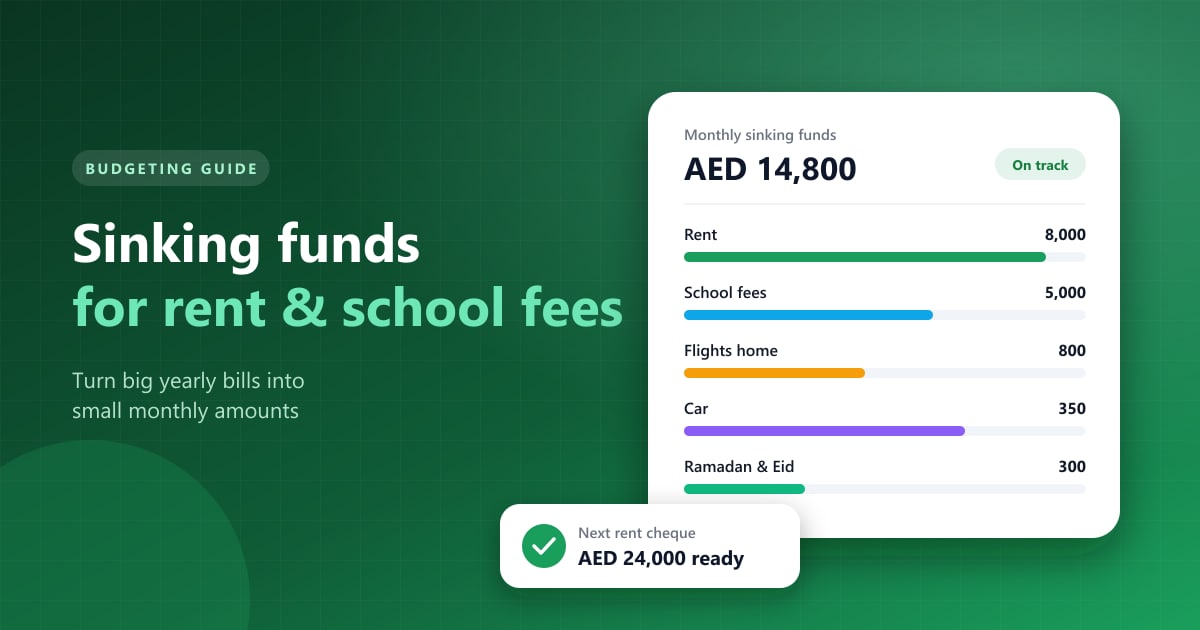
| Cost | Annual amount (AED) | How it's paid | Monthly sinking fund (AED) |
|---|---|---|---|
| Rent | 96,000 | 4 cheques of 24,000 | 8,000 |
| School fees (2 children) | 60,000 | 3 terms | 5,000 |
| Flights home (4 people) | 9,600 | Once, in summer | 800 |
| Ramadan and Eid | 3,600 | Spring | 300 |
| Car insurance and registration | 4,200 | Once a year | 350 |
| Summer DEWA increase | 2,400 | June to September | 200 |
| Visa and Emirates ID renewals (averaged) | 1,800 | Varies | 150 |
| Total | 177,600 | 14,800 |
That AED 14,800 a month is 53 percent of household income. It looks frightening written down, but none of it is new spending. This family was paying these costs anyway. They used to hit all at once. Now each one costs a steady monthly amount.
It also explains why so many UAE budgets feel impossible. When rent and school fees together take half of income, there's much less room for everything else than the monthly bills suggest. A sinking fund doesn't cause that. It shows it to you early enough to do something about it.
A smaller example: single, renting a studio
Sinking funds aren't only for families. Here's the same approach for a single professional earning AED 12,000 a month, renting a studio for AED 54,000 a year in two cheques.
| Cost | Annual amount (AED) | Monthly sinking fund (AED) |
|---|---|---|
| Rent (2 cheques of 27,000) | 54,000 | 4,500 |
| Flight home | 2,400 | 200 |
| Car insurance and registration | 3,000 | 250 |
| Eid gifts and travel | 1,200 | 100 |
| Total | 60,600 | 5,050 |
With only two cheques a year, each one is AED 27,000, more than two months of salary. Without a sinking fund, that payment almost always ends up on a credit card. With one, it's AED 4,500 a month that leaves on payday and comes back when the cheque clears.
What if the next cheque is due soon?
The monthly figure assumes you have a full year to save. If you're starting mid-cycle, you need a catch-up plan for the first payment.
Say it's November, you pay rent in four cheques of AED 24,000, and the next one is due in two months. Your long-run amount is AED 8,000 a month, but you only have two paydays, so you need AED 12,000 a month until January. After that cheque clears, you drop back to AED 8,000 and you're on schedule for every cheque after it.
If AED 12,000 a month isn't possible, you have a few options:
- Cover what you can and borrow the gap as cheaply as possible. A 0% installment plan on a credit card costs far less than carrying a balance at 3 percent or more a month (Emirates NBD's Key Facts Statement lists 3.25 to 3.49 percent). Read 0% installment plans in the UAE: are they really free? before you sign up for one.
- Ask your landlord about more cheques at renewal. Moving from four cheques to six or twelve lowers each payment, though some landlords charge more rent for it.
- Use your school's payment plan. Many UAE schools offer monthly or termly installments. Ask the finance office before the term invoice arrives, not after.
- Pause other savings for one cycle. Temporarily redirecting your regular savings to the catch-up is better than paying credit card interest.
The first cycle is the only hard one. Once you're caught up, every payment after that is already covered.
How to track several sinking funds without losing count
With one savings account holding money for rent, school fees and flights, the account balance alone doesn't tell you much. AED 30,000 sounds healthy until you realise AED 24,000 of it belongs to next month's cheque.
Track each fund as a separate goal with its own target, due date and balance. A spreadsheet with one row per fund works, as long as you update it every payday. An app like Fixpenses lets you set up each one as a savings goal with a target and deadline, so you can see at a glance whether you're on schedule. It also keeps your monthly spending limits next to them, so you're not spending money that's already spoken for.
If you pay your big bills by credit card, time them with your statement cycle so the money is in your account when the bill is due. Whatever you use, the rule is the same. Money in a sinking fund is already spent. It just hasn't left your account yet.
What to do with money left over
Sometimes a fund ends up with more than the bill. The flights were cheaper than expected, or the car insurance renewal came in lower. Resist the urge to treat the surplus as spending money.
Leave small surpluses in the fund and lower next year's monthly amount slightly. If the surplus is large, move it to your emergency fund or to whichever sinking fund is furthest behind. Just don't let it drift back into everyday spending, or you'll be short again next year.
Common mistakes to avoid
- Don't forget deposits and one-offs. School re-enrolment deposits, the security deposit on a new flat, and moving costs catch a lot of people out. Add them as separate funds the moment you know about them.
- Don't rely on last year's numbers. Rents and school fees can rise at renewal. Add a buffer of 5 to 10 percent, and update the target as soon as you get the new figure.
- Don't dip in for something else. If the car breaks down, that's what your emergency fund is for. Borrowing from the rent fund just moves the crisis to next month.
- Don't keep the money in your spending account. If your sinking fund sits in the same account as your debit card, it will get spent. Keep it separate.
- Don't stop once you're caught up. The standing order is what makes this work. Leave it running even in months when things feel fine.
Frequently asked questions
How many sinking funds should I have?
As many as you have big, predictable costs, but most households manage with four to six: rent, school fees, travel, car, festivals and a general "annual bills" fund for smaller items. Grouping small costs into one fund keeps it manageable.
Should my sinking fund earn interest?
It helps, but access matters more. A savings account with some profit or interest is ideal as long as you can move money out in a day or two. Don't lock sinking fund money in a fixed deposit that matures after your cheque date.
Is a sinking fund the same as saving?
Not quite. Savings build wealth over time. A sinking fund is money you've already committed to spend on a specific date. Keep them separate so you can see how much you're genuinely saving.
What if my income varies month to month?
Budget your sinking fund contributions from your lowest typical month, and top them up in strong months. Freelancers and people on commission should fund rent and school fees first, before any discretionary spending.
Start with the next big bill
Pick the next large payment on your calendar, whether that's a rent cheque, a school term or the summer flights. Divide the amount by the paydays left before it's due, and set up a standing order for that amount tomorrow. One fund, one standing order. Add the rest once the first is running.