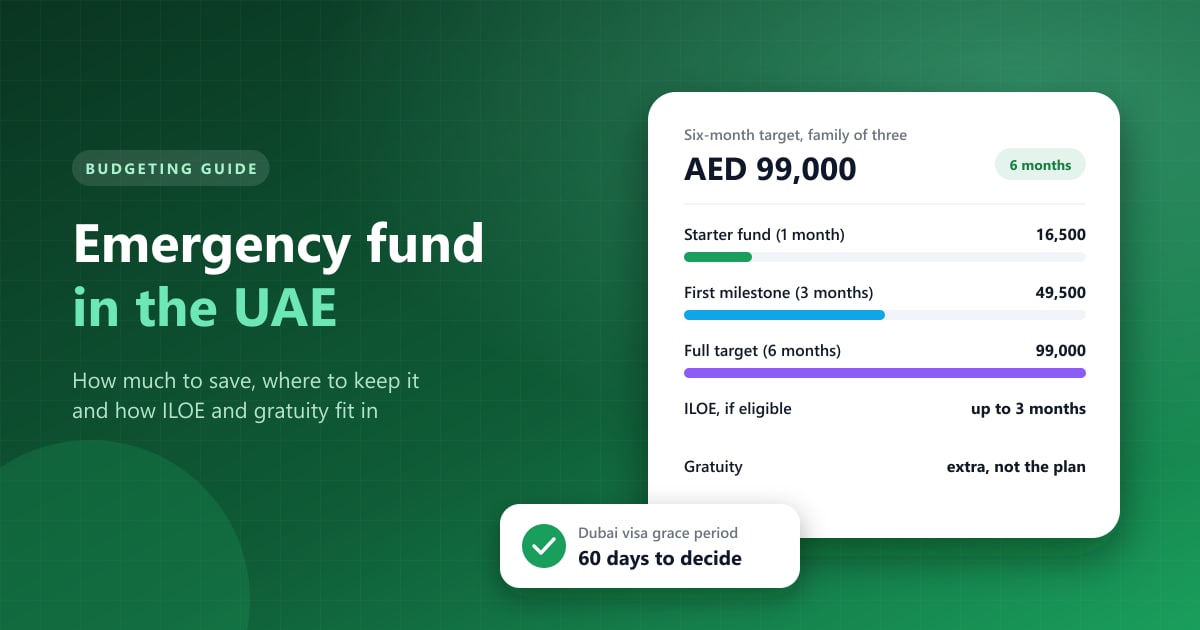
In most countries losing your job will mean you lose your income. However, in the UAE you will also face a countdown. When your residence visa is cancelled, Dubai's residency department gives you 60 days to leave. This can vary between emirates and residency types. In this time you need to find a new job, change your visa status or leave.
In the UAE having an emergency fund is extremely important. Not only will you need to continue to pay your bills whilst you look for a new job, but also it will give you time to make a considered decision.
This guide will tell you how big you should make your emergency fund, what insurance and gratuity cover in the UAE, where to store your money and how to start building it up from scratch. To get a better understanding of how to build a monthly budget in the UAE check out our guide.
Why it is more important in the UAE
There are several reasons why losing your job in the UAE can be more difficult than the global articles suggest.
Your visa will be tied to your job. This means if your family is on your sponsorship then their residency will also be affected.
There is very little support whilst you are looking for a new job. As an expat there is no state welfare system for you. Whilst there is some support through the Unemployment Insurance Scheme (ILOE), it only pays you a proportion of your basic salary and for a limited time.
Fixed costs will still be incurred. Your rental payment will still need to be paid and your kids school term will be paid in advance.
Your car loan, minimum payments on your cards and installments will still need to be paid. There may also be a cost associated with terminating your tenancy early. Check your contract for any early termination fees.
Costs associated with moving. If you decide to leave you will need to pay for flights, shipping or storage.
The emergency fund in the UAE will help you pay for your essentials whilst looking for a new job and to leave in an organised way.
What is covered by ILOE and gratuity?
Many people assume that their unemployment insurance and end of service gratuity will act as their emergency fund. However this is not the case.
Unemployment insurance (ILOE)
Most private sector and federal government employees are required to join the Involuntary Loss of Employment scheme. From the UAE government portal and policy terms:
- If your basic salary is AED 16,000 or below you will pay AED 5 per month. If your basic salary is above this you will pay AED 10 per month (plus VAT).
- If you are eligible you will be paid 60% of your average basic salary for the past 6 months.
- You cannot receive more than AED 10,000 per month (or AED 20,000 per month if on the higher bracket).
- You can only claim for 3 months per claim and will stop receiving payments if you find a new job.
- You will need to have been subscribed for at least 12 consecutive months.
- If you resigned or were dismissed for disciplinary reasons you will not receive any payments.
- You must claim within 30 days of the end of your job or 30 days from the date of any court ruling if you had a labour complaint. If you miss this window your claim could be rejected.
Whilst this is helpful to have there are some limitations. It is based on your basic salary which is often half or less of your overall package once you add in your housing and transport allowance. It is also only for 3 months and if you have not been in your job for a year or more, or if you resigned you will not receive anything.
End of Service Gratuity
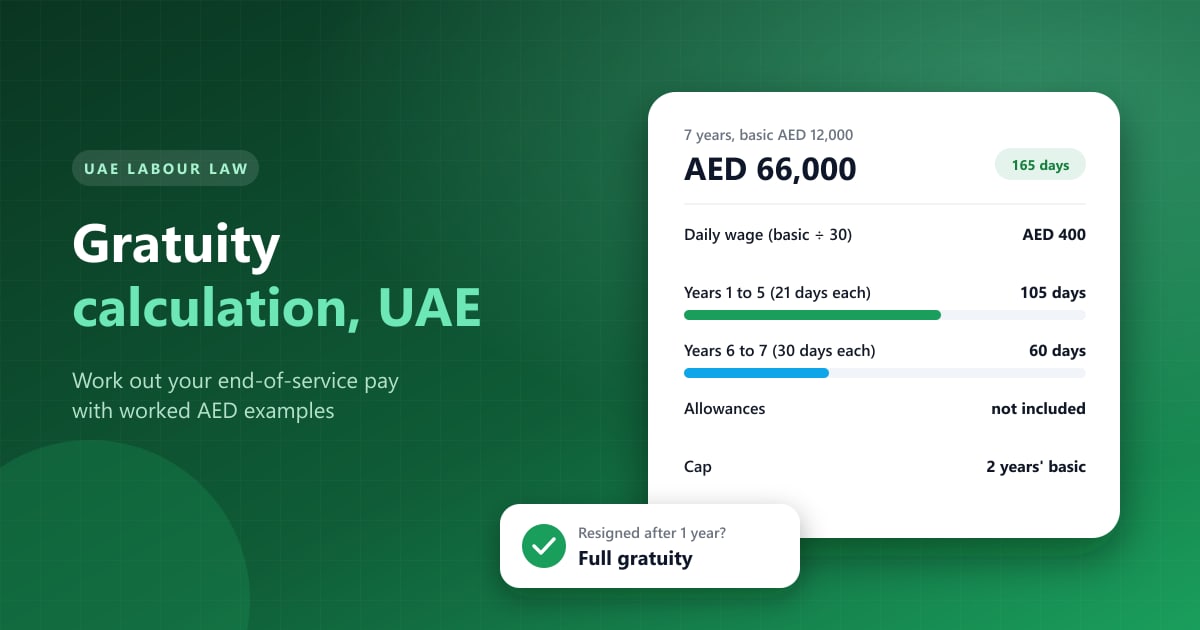
Most private sector employees will receive gratuity under UAE labour law. You will receive 21 days basic salary for the first 5 years and 30 days basic salary for each additional year. Employers must pay your final dues within 14 days of your contract coming to an end. Employees within the DIFC will have a different scheme called a workplace savings scheme. Some employers have moved employees onto the government approved voluntary savings scheme. This means that your gratuity will be invested during your employment.
Gratuity can be a large amount after many years however it is not a reliable emergency fund.
You may not have been employed for a year. Final settlements can sometimes be delayed or contested. If you have a personal loan linked to your salary transfer your bank may have a claim. Many banks will ask your employer to provide a letter stating that they will pay your final settlement to the bank first. This means that your gratuity can be used to pay off your loan.
| Safety Net | Pay | Notes |
|---|---|---|
| ILOE | 60% of Average Basic Salary (subject to maximum). Up to 3 months. | You need to have been subscribed for 12 months. Will not pay if you resigned. Only based on basic salary. |
| Gratuity | 21 or 30 days basic salary per year. | Need to have worked for 1 year. Only based on basic. Can be delayed. |
| Emergency Fund | Whatever you save | Only exists if you save. |
Plan to not receive either and if you do they are extra time.
How much should I save?
As a general rule you should aim to save 3-6 months of your essentials. In the UAE most people should aim for the higher end.
Start by working out your monthly essentials. This is what you would still pay if you lost your job tomorrow.
- Rent (Monthly)
- School Fees (Monthly)
- Groceries
- Utilities, Phone & Internet
- Transport (Car Loan & Fuel)
- Health Insurance for anyone your employer no longer covers
- Minimum payments on Cards, Loans & Installments
Don't include eating out, shopping, holidays or subscriptions you would cancel. Then multiply by the number of months you want to cover.
If you are single, have in-demand skills, no dependants on your visa and no debts then 3 months is a reasonable amount to aim for.
If you are supporting a family on one income, have dependants on your sponsorship, work on commission, are self employed or have not been subscribed to ILOE for 12 months then 6 months would make more sense.
If you are the sole earner with children in school or would like the option to relocate your family then you may want to aim for more than 6 months.
Example
For example if you are a one income earner with a family of 3 in Dubai earning a total package of AED 25,000 per month (basic salary of AED 12,500). This is just an example so use your own numbers.
| Essentials | Monthly Cost (AED) |
|---|---|
| Rent (Yearly divided by 12) | 7,000 |
| School Fees (Yearly divided by 12) | 2,500 |
| Car Loan & Fuel | 2,000 |
| Groceries | 2,000 |
| Minimum Card & Loan Payments | 1,000 |
| Utilities & Internet | 900 |
| Family Health Insurance | 800 |
| Phone | 300 |
| Total Essentials | 16,500 |
3 Months = AED 49,500. 6 Months = AED 99,000.
If they are eligible for ILOE they will receive 60% of their basic salary (AED 12,500). This means they will receive AED 7,500 per month (up to a maximum of AED 10,000). This means they will receive around AED 22,500. If they have been working for the same employer for 4 years they would receive 4 years x 21 days x (AED 12,500 divided by 30 = around AED 417 per day). This is AED 35,000.
In total they could receive AED 57,500 from insurance and gratuity. It can be tempting to save less but a sensible plan would be to use AED 49,500 as your first target and aim for AED 99,000. Any insurance or gratuity will simply increase the length of time you have.
Where to save
An emergency fund should be money that you have ready to use in full the week you need it.
Save it in a savings account in your name. Don't have it in your salary account and ideally don't have a debit card linked to it. You want to be able to access it within a day or 2 but don't want to accidentally spend it in the mall.
Don't save in stocks, crypto or anything that could lose value. You don't want to be locked into a fixed deposit or pay to break the contract early. It's better to have easy access even if you are getting a slightly lower rate.
If you would return home in a worst case scenario then maybe save some of it in an account in your home country.
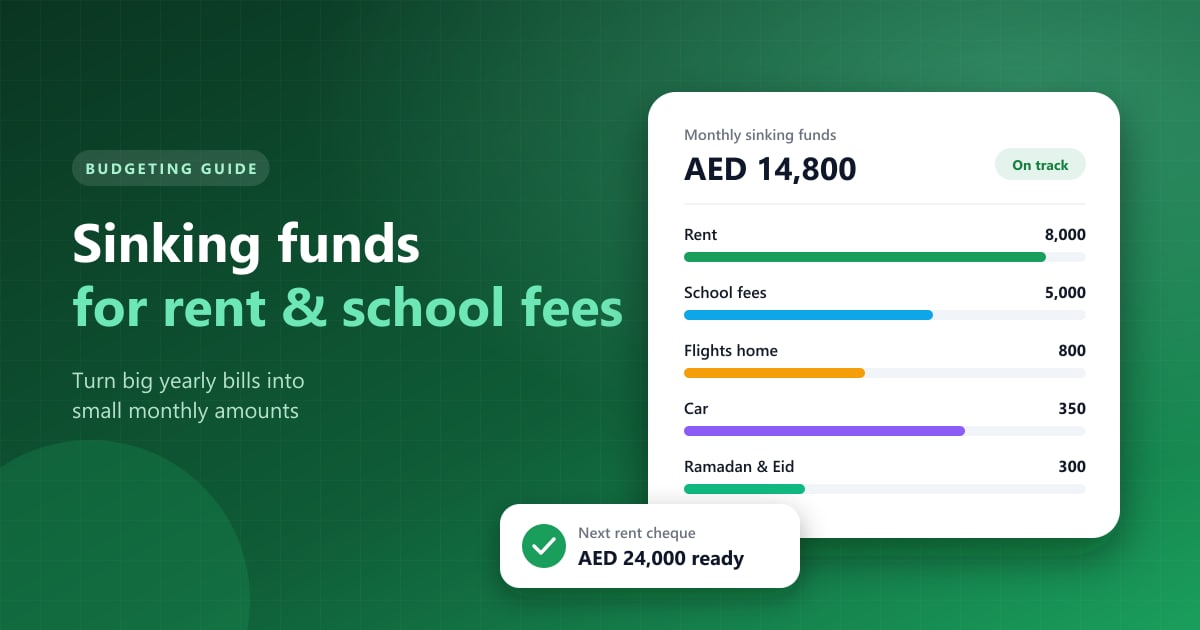
Keep it as one target. Don't mix it in with your savings for predictable costs. Rent and school fees should be in your sinking funds.
How to build from nothing
It can seem impossible to save 6 months of your expenses when your rental payments are taking up a chunk of your salary each month. Start small.
- Start by saving 1 month of your essentials. In this example it would be AED 16,500. This will help you avoid using a credit card for any car repairs or medical costs.
- Next pay off any high cost debt. Credit cards with 3% or above monthly interest will cost you more than any savings account. Installment plans will also eat into your savings. Keep your initial emergency fund untouched and try to pay off any extra to your credit card. Using our guide to understanding your credit card statement cycle will help you stop paying interest.
- Build up to 3 months. Set up a standing order to pay into your emergency fund the day after you get paid. Even if you're only saving AED 1,500 per month it will take less than 2 years to build up to 3 months for this example. It will be quicker if you have any windfalls.
- Build up to 6 months. Once you have 3 months saved keep your standing order going until you hit your target.
Having windfalls will speed this up. If you have an annual bonus, unused ticket allowance, tax refund from home or any money freed up from installment plans then these can all go straight into your emergency fund.
Fixpenses will allow you to set your emergency fund as a savings goal. This will show you how close you are each month and how many months of essentials you have saved.
When to use
Use your emergency fund for real emergencies. If you lose your job, have any medical costs not covered by your insurance, need to fly home urgently for a family emergency or have a car repair.
Don't use it for anything predictable. Rent, school fees, car registration per year, Eid and summer travel will all have set dates. These should be in your sinking funds. If you need to use your emergency fund for rent then this shows there is a gap in your budget. Use a sinking fund.
Once you have used it you should prioritise getting it back. Stop saving towards any other goals and get your standing order back going.
If you lose your job
Imagine you are a marketing manager in Dubai and you get made redundant at the end of March. Your next rent is due in April and your kids school term starts in May. Having 4 months of essentials saved will make the first week look completely different to if you had everything on a credit card.
Whatever your situation you should:
- Find out when your visa is cancelled and your grace period. Note down when your deadline is.
- Find out if you are eligible for ILOE and submit your claim well within the 30 day window.
- Find out when you will receive your final settlement and gratuity from HR.
- Immediately reduce your spending to just essentials.
- Contact your bank regarding any loans, cards or installments. Especially if you may leave the country.
- Work out how many weeks you have saved and plan your search.
FAQ
Should I invest my emergency fund?
No. The point of having an emergency fund is to have it available in full when something goes wrong. Often this is when the market drops. Once you have built up your emergency fund invest money you won't need for years.
Is my gratuity my emergency fund?
No. You need to have worked for at least a year, it is only based on your basic salary and can be delayed. If you receive it then treat it as extra time.
Do I still need an emergency fund if I have ILOE?
Yes. ILOE only pays 60% of your basic salary for up to 3 months per claim. You will only receive it if you have been subscribed for 12 months and did not resign. For most people this will only cover a proportion of your essentials for a proportion of the time.
How long will it take me to build my emergency fund?
It will depend on your income and costs. Usually you can build 3 months of essentials by saving 10-15% of your take home pay. This will take 1-2 years. Having bonuses will speed this up.
Start with 1 month
You don't need to have 6 months saved by your next pay date.
Tonight work out how much you need to save per month for your essentials. Open a separate savings account and set up a standing order to pay into your emergency fund the day after you get paid. This will be your first target. Once you have 1 month saved you won't panic if your car breaks down or you need to fly home suddenly. The more months you have the more time you have.